New statement calls for additional groundwater testing, independent scientific review and continued public engagement
For many Nova Scotians, recent headlines about the former Morvan Road dump in Shelburne may have been the first time they heard about the site or the decades-long concerns surrounding it.
The latest development comes in the form of a statement released by the Centre for Environmental Justice Society (CEJ) following a June 24 public town hall on the ongoing decommissioning of the former landfill.
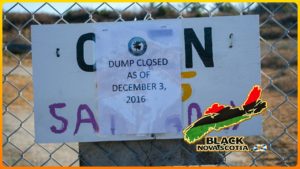
The Morvan Road site first opened as the town dump in the 1940s, when waste disposal sites generally had far fewer environmental protections than modern landfills. The site stopped accepting garbage in 2016, but that did not end the work. Even after a landfill closes, buried waste continues to break down for decades, requiring ongoing environmental monitoring to help ensure contaminants are not affecting nearby soil or groundwater.
Part of the current decommissioning process includes installing a new protective cap over the site and continuing groundwater monitoring.
One of the key issues is landfill leachate—the liquid that forms when rainwater or groundwater passes through buried waste. As that water moves through a landfill, it can carry metals, bacteria and other contaminants. Engineers monitor landfill leachate to determine whether it remains contained within the landfill or is moving into surrounding groundwater or waterways.
TIMELINE:
*1940s: Morvan Road dump begins operating.
*2016: Site closes and stops accepting waste.
*2022–25: Environmental racism panel and environmental studies continue.
*June 24, 2026: Public town hall on decommissioning.
*June 29, 2026: CBC reports on controversy surrounding the meeting.
*July 2026: CEJ releases its statement calling for additional monitoring and independent review.
What is CEJ calling for?
In its statement, CEJ says additional work is needed before residents can be confident they fully understand the landfill’s long-term environmental impacts.
The organization says testing conducted with Rural Water Watch detected substances including arsenic, manganese, iron, aluminum and total coliform bacteria in some residential wells. At the same time, CEJ also acknowledges that the available evidence does not conclusively show those findings were caused by landfill leachate.
Instead, the organization argues that more groundwater monitoring, additional testing, greater transparency and an independent scientific review are needed before firm conclusions can be reached.
Among CEJ’s recommendations are:
– installing additional groundwater monitoring wells;
– continuing quarterly groundwater testing;
– publicly identifying monitoring well locations;
– obtaining an independent review of the engineering findings; and
– holding another public meeting featuring independent scientific experts.
Why has this become a provincial conversation?
The environmental discussion received province-wide attention following the June 24 town hall after comments made by Shelburne Mayor Stan Jacklin, the town’s first elected Black mayor.
According to CBC News, Jacklin said the south end of Shelburne was not a Black community but rather a mixed community of Black, white and Indigenous residents. His comments prompted criticism from residents and community advocates, including his own sister, Darlene Cooper, who told CBC News she believed the remarks denied the history of the South End community. In a statement released after the meeting, Jacklin acknowledged that he had allowed his personal feelings to influence his comments and said he would be more mindful of the impact of his words.
The discussion has since prompted renewed interest in the history of Shelburne’s south end.
Writing for the Halifax Examiner, Tim Bousquet examined records from the 1931 Canadian census after questioning the mayor’s characterization of the neighbourhood. While he found that some white, Indigenous and mixed-race families also lived in the area, his review concluded that the south end was overwhelmingly home to African Nova Scotian families.
Bousquet also noted that many residents owned their homes and worked in skilled trades, on the railway and in local industries, challenging the idea that environmental racism is determined simply by whether a community is poor. Instead, the broader discussion centres on whether racialized communities have disproportionately borne the burden of environmental hazards and how those decisions were made.
Additional historical claims have also surfaced since the town hall. In a social media post, a Shelburne resident cited what they described as 1947 Town of Shelburne council minutes suggesting Douglas Jacklin was required to transfer the property for $1 or face tax proceedings, and that dumping on the site had already begun before the land transfer was completed in 1949. BlackNovaScotia.ca has not independently reviewed those council minutes or verified those claims.
Readers interested in the historical background may wish to read Bousquet’s full analysis alongside the recent reporting by CBC News.

What do we know about the environmental work?
The historical debate is separate from the scientific work currently taking place.
According to engineers with Dillon Consulting, testing has confirmed that landfill leachate exists within the former landfill, but there was no indication that it had affected nearby residential wells or adjacent waterways. The consultants nevertheless recommended that groundwater monitoring continue for the next 30 years as part of the site’s decommissioning, along with the installation of a new protective cap.
CEJ agrees that monitoring should continue but argues additional testing and an independent scientific review are needed before residents can have confidence that all questions surrounding the site have been answered.
Why does this matter beyond Shelburne?
Although the former Morvan Road landfill is located in Shelburne, the broader questions extend well beyond one community.
Across Nova Scotia, African Nova Scotian communities have long raised concerns about the placement of landfills, industrial facilities and other environmental hazards near their neighbourhoods. Those concerns have contributed to provincial studies, legislative changes and a broader public conversation about environmental racism.
Whether additional testing ultimately confirms or rules out further impacts from the former landfill, many residents, advocates and public officials agree on at least one point: the site will require years of monitoring and continued public transparency.
For Black Nova Scotians across the province, the story is not only about one former landfill. It is also about how communities preserve their own history, participate in decisions that affect them and ensure future generations inherit healthier environments than those of the past.
As work continues in Shelburne, the questions extend beyond groundwater testing alone. They include how history is remembered, how public institutions respond when communities raise concerns, and how environmental decisions made decades ago continue to shape conversations today.
Sources
– Centre for Environmental Justice Society (CEJ), Press Release: Decommissioning of the Town Dump (July 2026) — [CLICK HERE to view]
– CBC News, Shelburne mayor says dump was not in a Black community and is not a case of environmental racism (June 29, 2026) — [CLICK HERE to view]
– Halifax Examiner, Tim Bousquet, Fact check: Yes, the south end of Shelburne was a Black community (July 3, 2026) — [CLICK HERE to view]